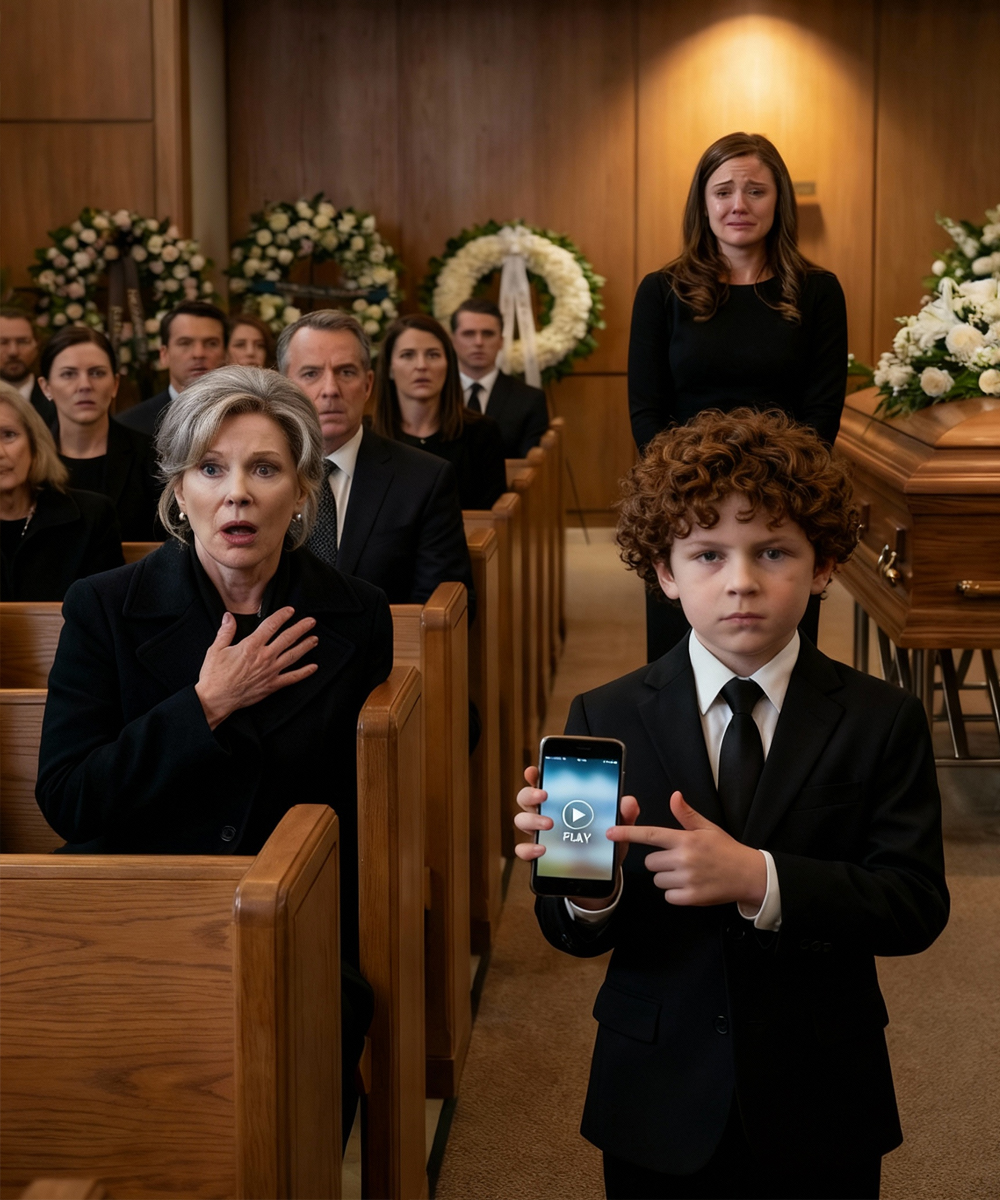
At my husband’s funeral, his mother fixed her eyes on me and said with chilling calm, “It’s better he’s gone than forced to live with the shame she caused him.” A few relatives murmured in agreement, some even nodding. Before I could find my voice, my eight-year-old son stood up, clutching his father’s phone tightly. “Grandma,” he said evenly, “do you want me to play the message Dad recorded about you last week?” Her face drained of color as the room dropped into complete silence.
The chapel smelled of lilies and freshly polished wood, the kind of stillness that presses against your chest. I stood beside Mark’s casket, my hands numb, staring at the closed lid as if it might suddenly open and undo the last seven days. Mark had been steady and unassuming—the kind of man who fixed things quietly and never asked for praise. He was gone at forty-two, and the chapel was filled with people who believed they understood him.
His mother, Diane Carter, shattered the hush. She faced me, chin raised, voice sharp. “Better he’s gone now than forced to live with the embarrassment she brought him,” she said loudly. Whispers followed. A cousin nodded. An aunt murmured approval. My throat tightened. I wanted to speak—to remind them of hospital nights and extra shifts—but grief locked my words in place.
Then I felt a small hand touch my arm.
Evan, my eight-year-old son, stood up from the pew. His black suit hung awkwardly on his growing frame. He held Mark’s phone with both hands, the case worn from years of use. His face was pale but composed, the way it looked when he focused on something important.
“Grandma,” Evan said clearly, “do you want me to play the recording Dad made about you last week?”
Diane’s expression faltered. Color drained from her face. “Sit down,” she snapped, then softened her tone. “This is not appropriate.”
Evan didn’t sit. He glanced at me, silently asking. My heart pounded, but I nodded. Mark had done nothing without purpose.
“You don’t understand what you’re doing,” Diane said quietly, stepping forward.
Evan’s thumb hovered over the screen. The minister shifted uneasily. Someone coughed. Chairs creaked as the room leaned closer.
“Dad said,” Evan continued, “that if you ever lied about Mom, I should press play.”

He did.
Mark’s voice filled the chapel—steady, familiar, alive.
“If you’re hearing this, it means my mother finally crossed a line…”
The room froze.
“…and I’m done shielding her,” Mark’s voice continued. “My name is Mark Carter. I’m recording this because my mother, Diane, threatened to spread lies about my wife unless I kept paying her bills and covering for her.”
Gasps rippled through the crowd. Diane’s hands shook.
Mark calmly detailed the fake loan, the credit card she’d opened in his name, the money she demanded and called obligation. He spoke of voicemails where she warned him that if he refused, she’d blame me for his illness. “My wife didn’t make me sick,” he said. “Carrying secrets did.”
Someone whispered, “Oh God.”
The recording wasn’t emotional—it was methodical. Dates. Amounts. Screenshots. Mark even mentioned the folder he’d hidden copies in. “I love my mother,” he said softly, “but love doesn’t mean allowing harm.”
Diane lunged toward Evan. “Turn it off!”
The minister stepped in. A cousin restrained her. The recording continued.
“If my son is hearing this,” Mark concluded, “remember: truth isn’t disrespect. It’s protection.”
Silence followed—dense and heavy. Then chairs scraped as people stood and quietly left. Others stared at the floor. My sister-in-law Karen wiped her eyes. “I didn’t know,” she whispered.
Diane collapsed into a chair, hollow. “He promised me,” she murmured. “He said he wouldn’t say anything.”
“He promised to protect us,” I said.
After the service, two people asked for copies of the recording. Karen was one. The other was a family friend—an accountant. “You should have this reviewed,” he said gently. “There are crimes here.”
Diane avoided me after that. She left early, her authority gone. Evan slipped his hand into mine, and for the first time since Mark died, I felt something solid beneath the grief—the truth.
The weeks that followed were quiet. Not peaceful, but subdued. Paperwork filled the days. Long nights followed. The accountant helped us file reports. A lawyer explained our options. Diane sent one message—an apology layered with excuses. I didn’t answer.